Workforce verification · Saudi Arabia & UAE
Know who was there. Not who says they were.
Hazri Book gives Gulf contractors attendance they can defend — photo, GPS, server-trusted time and an append-only audit trail behind every shift. Payroll stops being an argument.
Live in production with a Saudi contracting company · 157 workers onboarded
The problem
A register records a claim.
It does not record a fact.
Paper registers and tap-to-clock apps capture what someone entered. When payroll is questioned four weeks later, that is all you have.
Hours you cannot prove
A worker disputes a short week. The register says one thing, the supervisor remembers another, and there is no evidence either way.
Attendance marked from the office
One person signs in for a crew who never arrived. Nothing in the record distinguishes a real arrival from an assumed one.
A month you cannot close
Payroll waits on chased-up corrections. Nobody can say which numbers are final, and the same argument repeats next month.
How verification works
Four things happen at every punch.
The worker taps once. Everything else is recorded whether they think about it or not.
The person is captured
A selfie is taken at the moment of the punch. Presence is evidenced by a face, not by a PIN somebody else could type.
The place is measured
GPS with accuracy, evaluated against the assigned site's radius. A punch from outside is flagged for review — never silently accepted, never silently thrown away.
The time comes from the server
Payroll uses the time our servers received the punch. The phone's own clock is stored separately, so a changed device clock shows up instead of hiding.
The record is sealed
Captured punches are append-only. Corrections are added as tagged entries with an author and a reason — the original survives.
Why this is different
Most systems track attendance.
This one produces evidence.
Attendance tracking
- Records what was entered
- Trusts the device clock
- Blocks or ignores an out-of-area punch
- Edits overwrite the original
- Needs a connection to work
- Produces a report
Workforce verification
- Records what can be shown to be true
- Stamps time server-side, keeps the device clock as a tell
- Flags it, keeps the evidence, routes it to a supervisor
- Corrections are additive and attributed
- Captures a full punch with no signal at all
- Produces a record that holds up in a dispute
For your team
Built for the five people who touch a shift.
Worker
One button. A selfie. Done in seconds, in any signal. Sees their own hours, requests leave, signs in with a company code and PIN — no email address needed.
Supervisor
Today's crew ordered by what needs doing, not alphabetically. Who is on site, who is unmarked, who is flagged. Mark a whole gang in one action.
Project manager
Overtime is authorised before it is worked, and paid only where authorisation and worked hours agree. Raising and approving are separate jobs.
HR & general manager
Month-close with a hard lock, payroll-shaped exports, credential expiry tracking, and a dashboard that counts every attendance subject — office staff included.
The product
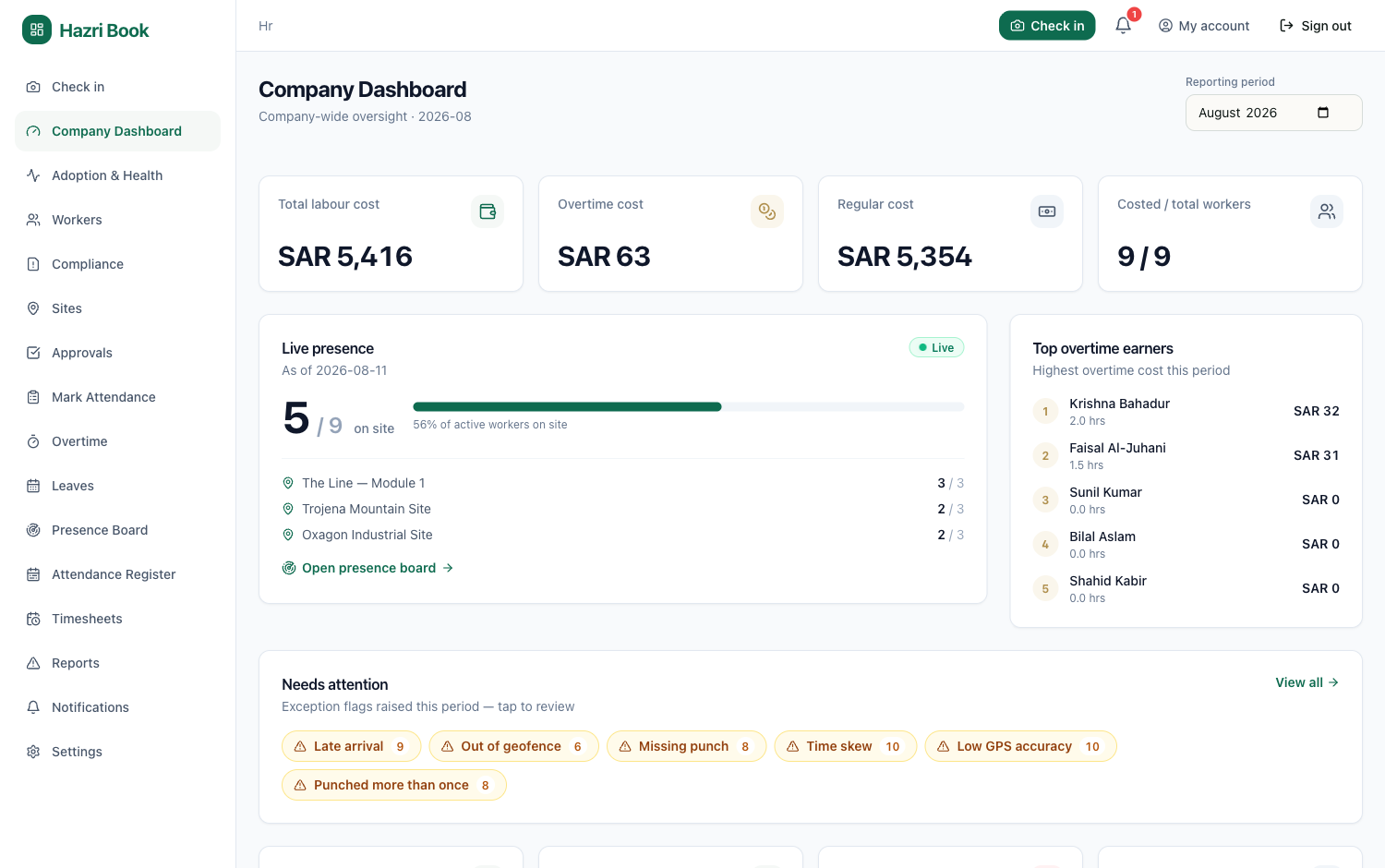
What your team actually sees.
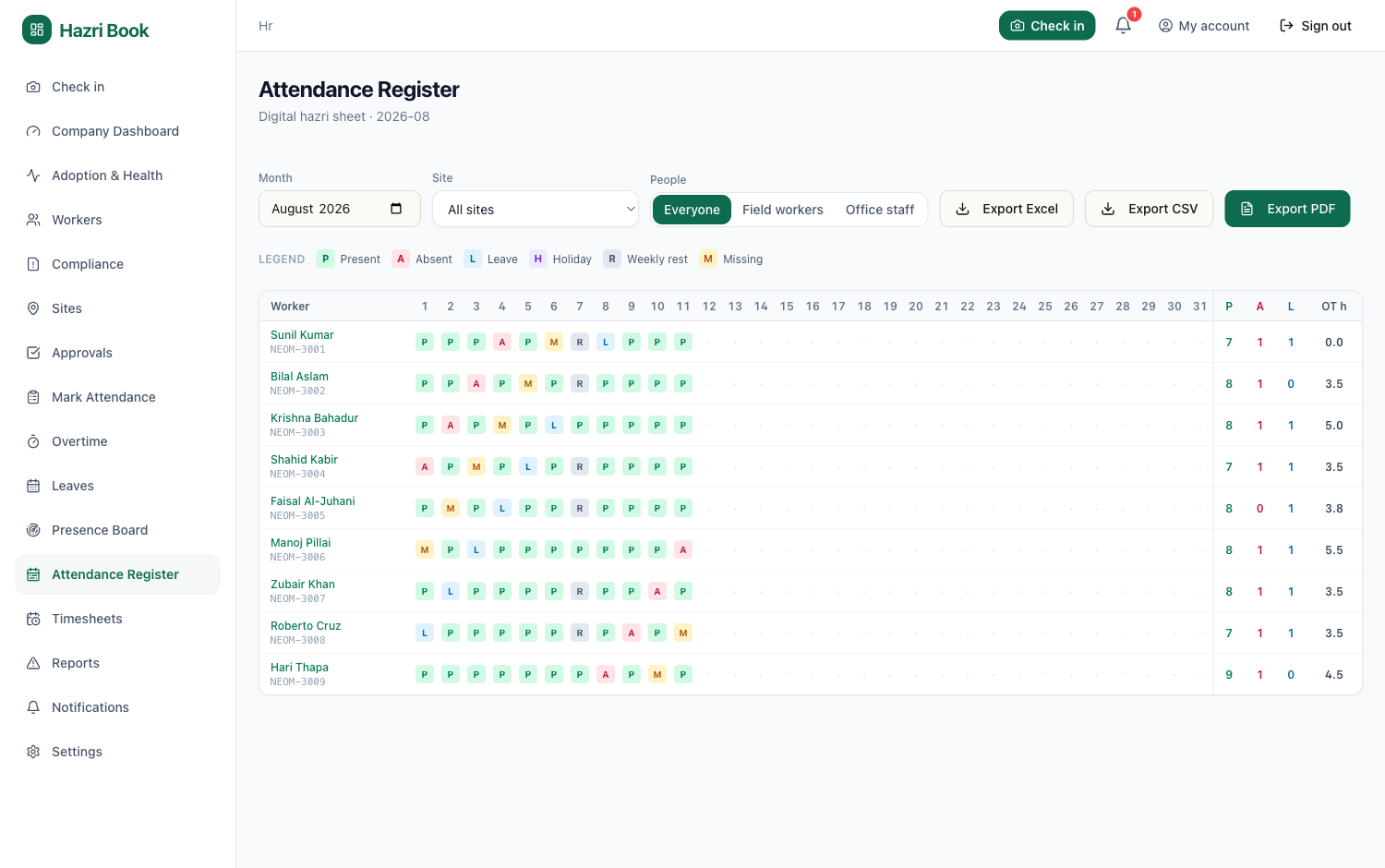
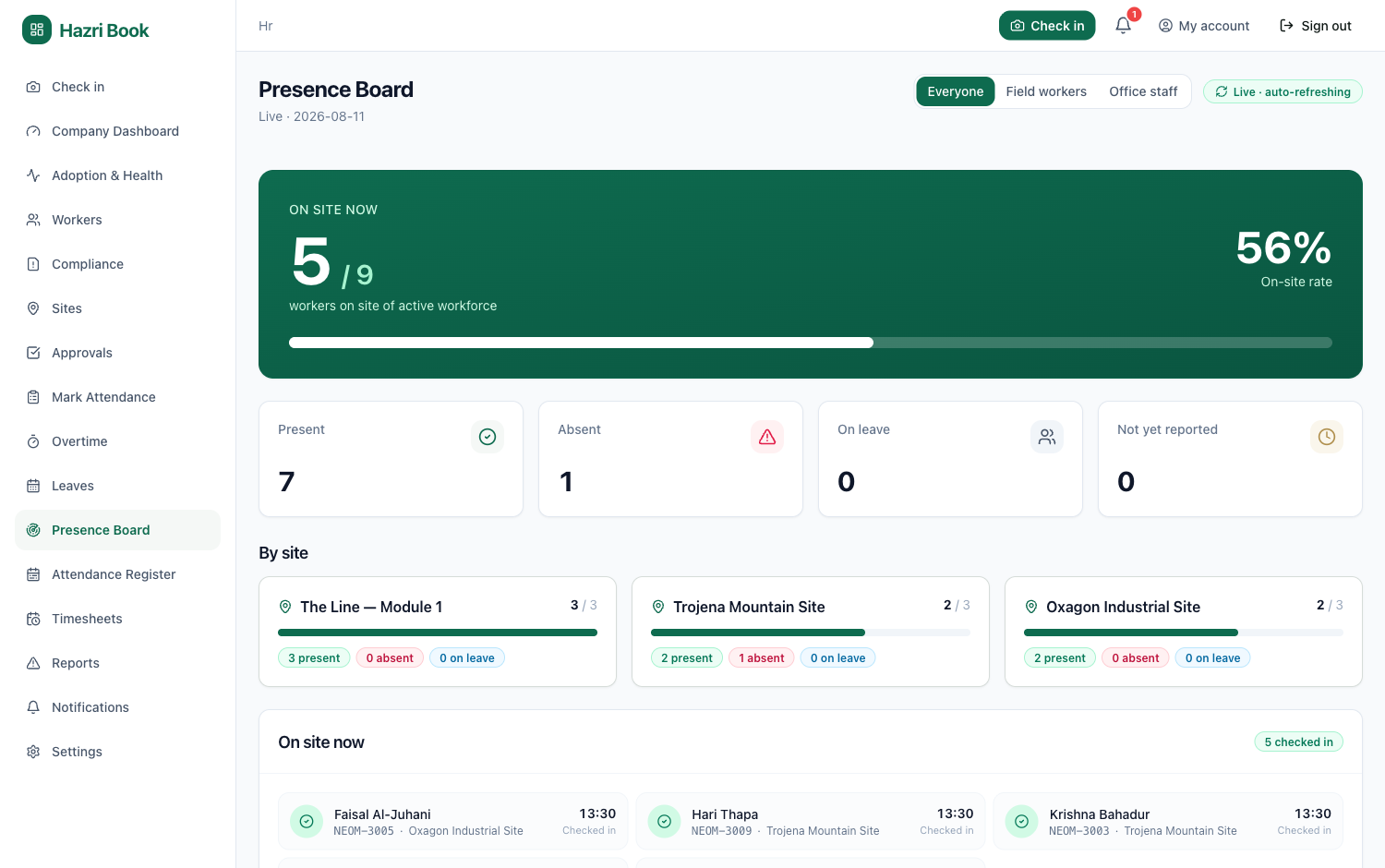
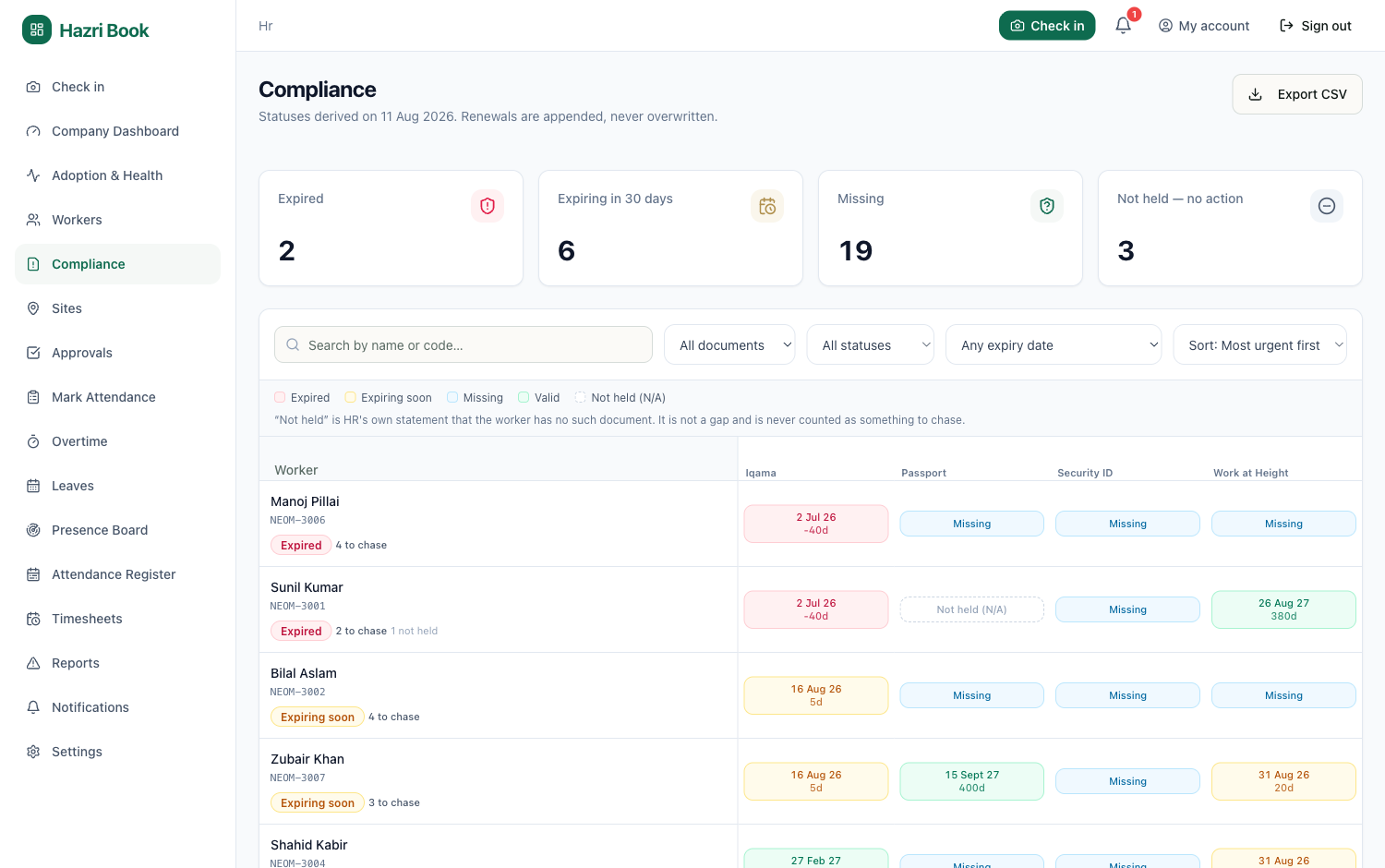
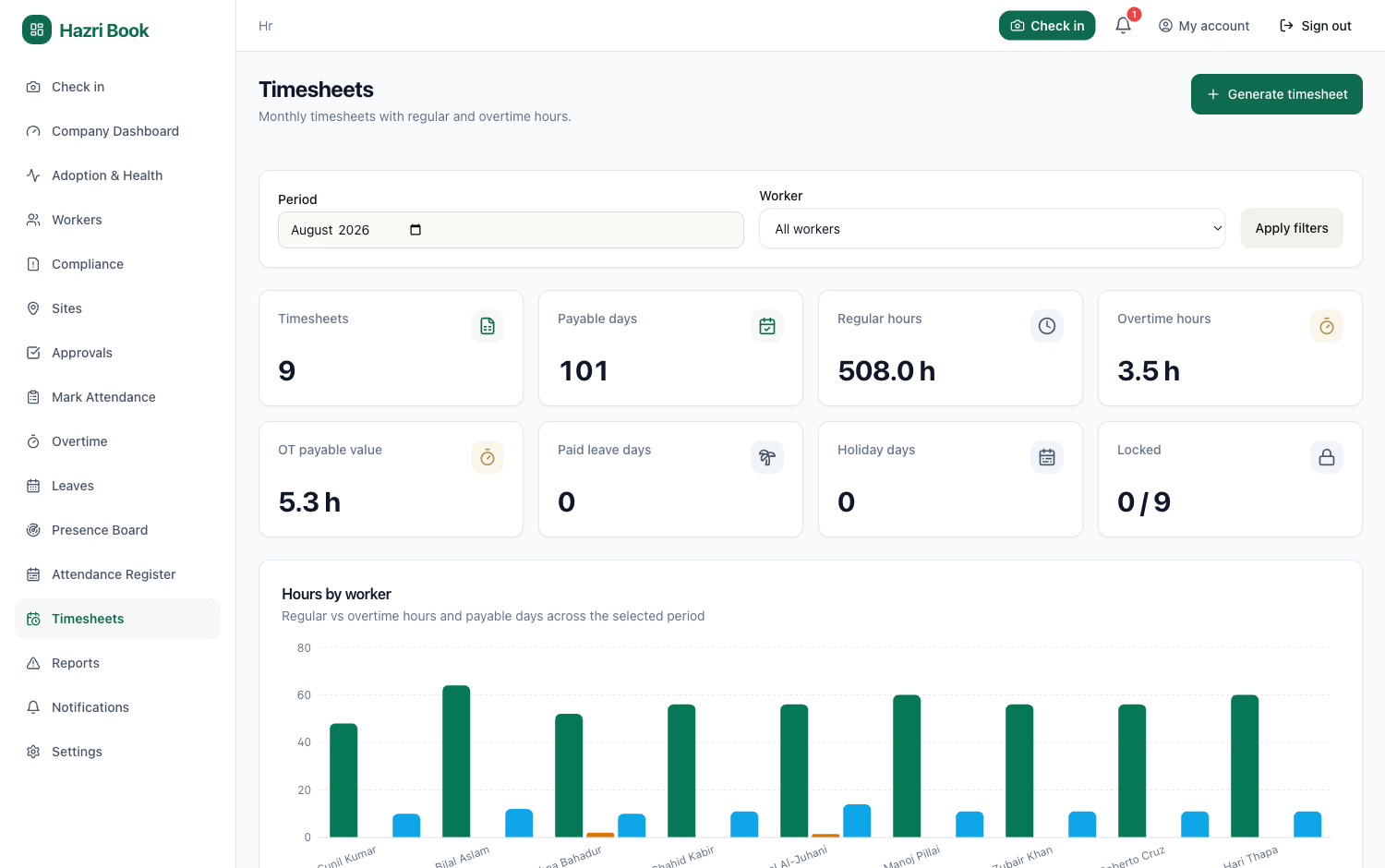
These are the office screens, captured from a demonstration company and never from a customer's data. The worker's half of the product is deliberately not pictured here: it is one button on a phone.
Evidence & security
Designed so the record survives scrutiny.
Not a feature list — these are the decisions that decide whether your data holds up when somebody challenges it.
One company cannot see another
Every query is scoped to your company from the session, never from the request. Isolation is enforced in the data layer, not by a filter someone can forget.
Nothing is silently overwritten
Approvals, edits, overrides and month-locks all append to an audit log with an author and a timestamp. You can always show how a number became final.
Photos are never public
Attendance photos are served only through short-lived signed links, to authorised office staff. Nothing sits in an open bucket.
Payroll time is our time
Server-received timestamps are what get paid. A tampered phone clock becomes visible evidence rather than a silent adjustment.
Access matches the job
Role defaults with per-person overrides. A supervisor approves attendance, a project manager approves overtime, HR locks the month — and the separation is enforced.
Your data stays in the Kingdom
Production runs in Riyadh on Oracle Cloud me-riyadh-1 — application, database and attendance photographs. The earlier Singapore deployment was decommissioned in September 2026 and its copy destroyed, so Riyadh is the only copy of your data.
Payroll & compliance
Attendance that arrives payroll-ready.
Overtime that was authorised first
A supervisor raises it, a manager approves it, and paid overtime is the overlap of what was approved and what was actually worked. No retrospective surprises.
Gulf rules, not generic defaults
Rest days follow the worker — Friday for expatriates, Friday and Saturday for GCC nationals. Public holidays, leave types and entitlements are per company.
Credentials before they expire
Iqama, passport and safety certificates tracked with automated reminders at 90, 60, 30, 14 and 7 days. An expired document flags the office — it never blocks a worker from recording their day.
A month you can lock
HR closes the period. Locked records are not silently mutated afterwards, so the numbers you sent to payroll stay the numbers you sent.
Exports that fit your process
CSV, XLSX and PDF, shaped for wage-protection filing. Attendance register, timesheets and per-worker timecards.
Arabic and English
Right-to-left throughout, designed in from the start rather than retrofitted. Worker languages follow.
Who it is for
Built for companies with people in more than one place.
If your workforce signs in somewhere you are not standing, attendance is a claim until something backs it. That is the same problem in every one of these.
Construction & general contracting
Several active projects, subcontracted crews, and a month-end that has to reconcile against the client's own records.
MEP & industrial services
Technicians moving between sites within a day, where the question is not whether they worked but where.
Manpower & labour supply
You invoice for hours on somebody else's site. The evidence behind the invoice is the product.
Facilities management
Fixed rosters across many buildings, where a missed shift is a contractual failure before it is a payroll line.
Infrastructure, oil & gas services
Remote sites, intermittent connectivity, and audits that arrive months after the shift they are asking about.
Cleaning & support services
High headcount and thin margins, where an hour that cannot be proven is an hour argued over.
What changes
Turn attendance administration into a controlled process.
No percentages here, because we have not run a study we would be willing to defend. These are the operational changes the product is built to produce.
Fewer disputes
When an hour is questioned, payroll has the photograph, the measured location and the server time rather than a recollection.
Less manual work
Supervisors stop reconstructing a month from paper, because the month assembled itself as it went.
Visibility across projects
Presence and exceptions across every site in one place, instead of a phone call to each foreman.
Payroll control
Overtime authorised before it is payable, and a month that locks so the number stops moving once it is agreed.
Deployment
One customer. In production. Not a pilot.
We would rather show you the deployment than a quote. Here is exactly where it stands.
A Saudi contracting company
157 workers onboarded with company code and PIN. Supervisors approving daily. Overtime authorisation, leave and month-close all live. Becoming their official attendance system of record in August 2026.
What we will tell you on a call
What went wrong during rollout and how it was fixed, which features they use daily and which they ignore, and what we would do differently. Ask for the reference and we will arrange it.
The honest part
The risk you are actually taking.
We are a small company with one customer in production. You are considering putting your payroll's system of record on it. That is a real question, and the answer is not "trust us" — it is what we have already signed.
Your data is exportable any day, not just the last one
CSV, XLSX and PDF, for the whole history, at any time during the term — not a leaving gift. The month you closed is a file you already hold, on your own systems, before anything goes wrong.
You can leave on sixty days' notice
For convenience, no reason required, with the unused portion of any quarter refunded pro rata. On termination we provide a complete export on written request. That is in the contract, not in a support policy we can change.
Your contract cannot be handed to someone else
Assignment requires your written consent. If this company is ever sold, you decide whether your workforce data goes with it.
What we do not offer
No committed uptime percentage. We have not signed one and we will not pretend otherwise — an availability commitment is a priced addition that has to be agreed in writing. If your operation needs one, say so on the call and we will quote it.
Your records sit in Riyadh on Oracle Cloud me-riyadh-1 — application, database and photographs, with no second copy outside the Kingdom. How that is set up.
Rollout
Start with one project.
There is no reason to move an entire company at once, and good reason not to. One project proves the workflow against your own payroll before anyone else has to change how they work.
Company and sites
We configure your company, the sites and their geofence radii.
Workers imported
From a spreadsheet. No email address required — workers sign in with a company code and a PIN.
App installed
Android and iPhone. The worker screen is one button.
First month closed
Supervisors review exceptions as they appear, and HR locks the period and exports it for payroll.
We will tell you on the call how long your rollout takes, based on your worker count and how your sites are organised. We would rather quote that than a number from a brochure.
Questions
What contractors ask first.
Will this work on a site with no mobile signal?
Yes. The worker app captures a complete punch — photo, GPS, timestamps — with no connectivity, stores it on the phone, and syncs when signal returns. Sites in the Gulf are remote and signal is worst exactly at shift change, so offline capture is the default path rather than a fallback.
Our workers share phones and do not have email addresses.
Sign-in is a company code, an employee or Iqama number, and a six-digit PIN. No email, no personal account. A shared site phone can be used by different workers, and each punch is attributed to whoever signed in.
What happens if a worker checks in away from the site?
The punch is recorded and flagged, with the distance from the site boundary. It is not blocked — refusing it would destroy evidence that the person was somewhere — and it is not silently accepted. It goes to a supervisor to resolve.
Can attendance be edited after the fact?
Corrections are added, never substituted. Each one records who made it, when, and why, and the original device-captured punch remains. Once HR locks the month, the closed records are not silently changed.
Where is our data stored, and what about PDPL?
In the Kingdom. Production runs in Riyadh on Oracle Cloud me-riyadh-1: the application, the PostgreSQL database and the attendance photographs. We moved in August 2026 and decommissioned the previous Singapore deployment in September, deleting its copy — so there is no second, out-of-Kingdom copy of your records.
To be precise about the law: PDPL does not require localisation for this data. Article 29 and the 2024 Data Transfer Regulations permit transfer abroad with safeguards, and private-sector employee data sits outside the CST cloud-registration framework. We host in-Kingdom because contractors and their clients would rather it was, not because a regulation forced it. Photos are served only through short-lived signed links.
How is this different from time-tracking or attendance software?
Time-tracking software records what was entered. This records what can be shown: photo, measured location, server-stamped time and an append-only trail. The output is not a report — it is evidence you can put in front of a worker, an auditor or a labour office.
How long does rollout take?
Workers are imported in bulk from your existing register, with codes and PINs issued for print. Supervisors are productive the same day. The realistic constraint is getting the app onto workers' phones, and we will be direct with you about that on the call.
Book a demo
Bring one month you argued about.
Thirty minutes. We will walk your own scenario through the product — a disputed week, an overtime claim, a month you could not close — and you will see exactly what the record would have shown.
Saudi Arabia & UAE · Arabic and English · No trial sign-up, no credit card